
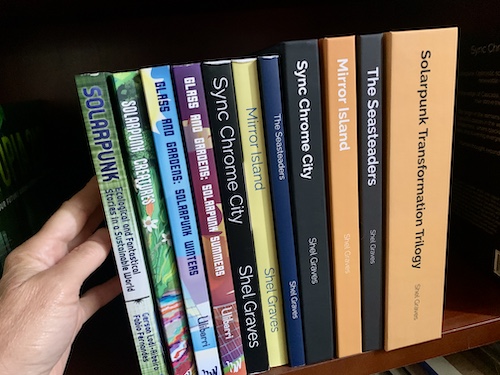
The Solarpunk Transformation Trilogy books are standalone novels set in the same universe, a near future Pacific Northwest.
Chronologically, Sync Chrome City happens first followed by Mirror Island shortly thereafter and The Seasteaders last.
However, they don’t need to be read or enjoyed in that order. If you are new to solarpunk, you might choose the book which fits your interests.
Sync Chrome City has a grittier feel and some cyberpunk elements. Fans of William Gibson’s Neuromancer and Neal Stephenson’s Snow Crash might start here. It’s set at a university by the Salish Sea and there’s a coming of age vibe so this might appeal to YA readers, too. I wrote this one while I worked at a community college. I read a lot about how the brain works and psychic studies while writing this one. It features DJs, dancing, and body modifcation.
Mirror Island is the science fiction summer beach read that I always wanted. It has some philosophical and metaphysical aspects including Tibetan tulpas. I read a lot about teleportation while writing this. It reminds me of Aldous Huxley’s Island and Tove Jannson’s The Summer Book. I drew on my experience working in newspapers (print!) for this. It definitely has some “I wish I could escape the office” vibes and features surfers and love of travel.
If you tend to prefer fantasy, then The Seasteaders might be your starting point. It is set further into the future and further out from the coast, after the Rust Seas have risen forcing people to live atop islands. I researched the real life practice of seasteading (homesteading in lawless international waters) for this book as well as the historical, mythological, and fantastical civilizations of Atlantis and Mu. This book is not afraid to get weird and if you like ocean and underwater fantasies with sea creatures. This book has a bit of Jules Verne and China Miéville vibes. I was reading Borges, Hesse, and Calvino. Marta Randall’s Islands is a a perfect companion read for this.
All of the books have philosophical and metaphysical leanings, encouraging us to think about the future (s) we want and how we can transform (neuroscience, physics, biology) to make those realities happen.
 Sheltopian Press