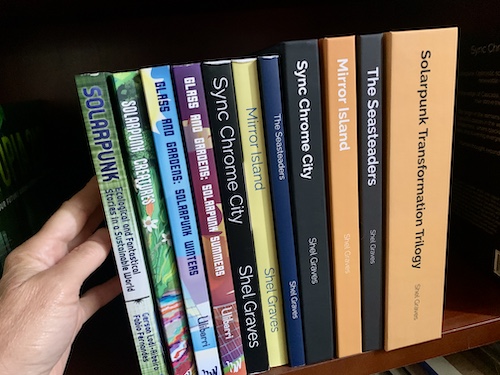
However, they don’t need to be read or enjoyed in that order. If you are new to solarpunk, you might choose the book which fits your interests.
Sync Chrome City has a grittier feel and some cyberpunk elements. Fans of William Gibson’s Neuromancer and Neal Stephenson’s Snow Crash might start here. It’s set at a university by the Salish Sea and there’s a coming of age vibe so this might appeal to YA readers, too. I wrote this one while I worked at a community college. I read a lot about how the brain works and psychic studies while writing this one. It features DJs, dancing, and body modifcation.
Mirror Island is the science fiction summer beach read that I always wanted. It has some philosophical and metaphysical aspects including Tibetan tulpas. I read a lot about teleportation while writing this. It reminds me of Aldous Huxley’s Island and Tove Jannson’s The Summer Book. I drew on my experience working in newspapers (print!) for this. It definitely has some “I wish I could escape the office” vibes and features surfers and love of travel.
If you tend to prefer fantasy, then The Seasteaders might be your starting point. It is set further into the future and further out from the coast, after the Rust Seas have risen forcing people to live atop islands. I researched the real life practice of seasteading (homesteading in lawless international waters) for this book as well as the historical, mythological, and fantastical civilizations of Atlantis and Mu. This book is not afraid to get weird and if you like ocean and underwater fantasies with sea creatures. This book has a bit of Jules Verne and China Miéville vibes. I was reading Borges, Hesse, and Calvino. Marta Randall’s Islands is a a perfect companion read for this.
All of the books have philosophical and metaphysical leanings, encouraging us to think about the future (s) we want and how we can transform (neuroscience, physics, biology) to make those realities happen.
What a party! Unforgettable! It was Dec. 31, 1999.
Cue Prince:
“They say, 2000-00, party over Oops, out of time We’re runnin’ outta time So tonight we gonna party like it’s 1999” — Prince, 1999
This party took place in an airplane hanger strung with lights at a compound in the woods. I was wearing a black velvet hoodie bought specially for the purpose, because what do you wear when you want to look fancy on New Year’s Eve, but will also be outside in the cold? Sometime before midnight or possibly after, a bunch of people including my spouse, jumped naked over a bonfire. Surrounded by friends old and new, we escaped the perils of the changing clock into the aughts. In the morning, voice husky with reverie, and possibly retelling some story having to do with eating a straight habenero or a ghost pepper, Jim sang Ring of Fire by Johnny Cash.
We all joined in.
“Love is a burning thing And it makes a fiery ring Bound by wild desire I fell into a ring of fire I fell into a burning ring of fire I went down, down, down And the flames went higher And it burns, burns, burns The ring of fire The ring of fire” —Johnny Cash, Ring of Fire
The following New Year’s Eve, those of us still bound to the Earth would be on a coast watching the sun rise over the ocean. Instead of enjoying reverie, we’d be reflective. Thoughtful and sad.
Y2K entered peacefully those first days. The foretold technological collapse, computer systems scrambling air traffic control and a host of other systems we took for granted, did not come to pass. People had prepared and worked to prevent chaos, but those early days it felt like good fortune (and a lot of unnecessary worry). My spouse and I got up as usual and went to work.
A month later, Jan. 31, 2000 we would get a call in the middle of the night. After some sleepy hesitation, we would get up and travel south to our friends’ home. Alaska Airlines Flight 261 had gone down into the Pacific Ocean off the coast of California. There were no survivors.
A group of friends returning from Mexico for a trip to celebrate their 30th birthdays were on it. Jim was a flight attendant on Alaska Airlines. They were college friends of college friends. An older group of friends we were just getting to know better, close friends of our close friends.
We gathered together after that. We grieved. There was a wake. There was an emptiness and an absence that remains. There are annual gatherings at a pub in the University District.
Grief doesn’t go away over time. You walk with it until it becomes bearable. The heaviness sinks into your cells. In many ways, it becomes more penetrating over time. I’ve thought of those friends at all of the marriages, births of children, parties, and milestones over the years. Years of loss and thoughts of what might have been.
On the last night of 2000, walking on the beach we talked about what we wanted in 2001. I said aloud that I wanted to write a novel. I told myself a story about how art had been lost in the world with the absence of those friends and I felt called to add my art. That was my story anyway.
It was an urgent call, but also a persistent call. It began a long journey in which I began to write my first novel Sync Chrome City.
That first novel was a challenge. I didn’t know if I could do it. I had to develop a writing habit. I started writing on my lunch break when I worked at Edmonds Community College in public relations. I would take out my laptop and think about characters or write a scene.
I wanted more time to write, but I lacked the stamina to write for hours. I was plotting and creating bit by bit. I had a process, but I didn’t know it yet.
I had to develop a habit of writing. I read and listened to a lot of writing advice. Write. Write every day. Writer’s write. I began to do this.
I did not “always want to be a writer”. I was an avid reader more than anything. I had written some stories, writing was a way I knew how to express myself and it was my profession. I went from college essays, to newspaper stories, to press releases.
Novel writing was different. It was artistic. It was creative. I was in awe of those things. I worshipped authors — so how could I be one?
Still, determined, motivated, inspired, and perhaps sad and afraid, I began. I read books about how to write. I took Certificates in Popular Fiction at the University of Washington. I judged a Pacific Northwest Writers Association competition.
Along the way, I also developed a passion for what I wanted to write, my contribution. I wanted to write science fiction that would inspire the future. I wanted to write optimistic science fiction that would envision the world we wanted. Instead of dystopia, I wanted to write utopias. Later, I would find others writing in a similar way who shared this vision and I would feel less alone.
Sync Chrome City was set on a college campus. It was about a group of college friends. My spouse and I met at college and I fell in love with him at first sight across the floor at an 80s dance held in the Viking Union lounge at Western Washington University. That’s all in there.
I was also worked at a college as I wrote. As I struggled to turn characters and ideas into a readable plot, I drew on some of the natural rhythm of college life – the stress of finals, the desire to graduate, the uncertainty of what would come next.
I really wanted to write science fiction. I was an avid Bradbury, Asimov, Heinlein reader as a high school student then jazzed on William Gibson’s Neuromancer right before going to college and later Neal Stephenson’s Snow Crash. In college, I began to look to women authors and this led me to Atwood, Willis, Le Guin, Tepper, and Butler. I connected with their works.
Because I do things the hard way, I wanted to make sure there was science in my science fiction so I went on a reading binge about neuroscience and psychic abilities.
I wanted a book about change for the better, but I wanted that change to come not from technology, aliens, or devices. The change would come from within ourselves. We would change. Sync Chrome City is about humanity changing our minds. It’s about us deciding to be together. It’s about connection.
After I finished Sync Chrome City — actually wrote a novel with a beginning, middle, and end — I set it aside. Your first novel isn’t supposed to be good.
So, I began writing my second novel and now, with a solid writing habit, I applied for a Master of Fine Arts program.
I wrote Mirror Island, my second novel, while I was working full time and obtaining my Master of Fine Arts in Creative Writing in a low residency program. Do you need an MFA to write? Not at all, but I so admired artists and noted how many of them that I did admire had those letters after their name.
I was in love with the whole idea of pursuing this degree and enamored of being part of that group of writers.
Goddard College at Port Townsend was a magical place, too. I went there for residencies and ran and wrote on the beach by the lighthouse. I loved being around all of the writers.
What I loved most about the program: reading. More than anything, the writers who taught the classes expanded my reading list.
Victoria Nelson wrote and introduced me to more and more imaginative writers who expanded what was possible.
In Mirror Island, I remained committed to writing optimistic science fiction. For this novel, I read physics books and book about the latest advancements in teleportation research. I also remained tied to my theme that the catalyst for positive changes comes not from without but from within.
Mirror Island was set adjacent to the utopia I created in Sync Chrome City. That novel featured a far future Pacific Northwest, Cascadia that had broken away from the United Government to form its own utopian enclave, New West.
Mirror Island focused on a similar enclave nearby but inland held in place by strict rules and an overbearing personality Rock Traynter, who held C-town static in a tight unchanging grip.
In Sync Chrome City, my protagonist Geneva Teresa Weltraum, who is just trying to pass her finals, discovers psychic abilities that allow her to transform matter when she connects to her group of college friends.
In Mirror Island, this theme goes a step further. Doreena Flora Moriena is actually an alien being held in place by others’ thoughts. She discovers her true transformative nature, when she begins to visit a magical island.
Since I was working and working on my MFA, a level of stress that nearly broke me, I loved that I chose to write about sexy, beautiful, island magic for my thesis. Because my imagination was being stoked in the hot fuels of writers like Bruno Schulz, Jorge Luis Borges, Margaret Cavendish, Leonora Carrington, Marge Piercy, and Naomi Mitchison; it got a bit weird.
By the time I wrote The Seasteaders, I had thoroughly developed a writing habit. I was also no longer afraid to be weird. My struggle was never lack of ideas and I challenged myself to write when I had a new idea, which was often. Seeing the ideas to completion was hard.
The opening scene of a child escaping came to me in a dream, but the novel was inspired by a newspaper article about a seastead. If you live in international waters you can make your own laws. What a perfect setting for a utopia!
The Seasteaders is set in the same far future Pacific Northwest but on the islands and now the Rust Sea has risen further. The genetic manipulation of animals begun in the labs at New West University years ago mentioned briefly in Sync Chrome City has now spread. So the islands have a fantasy feel with unusual kowal and ratfin creatures. Our protagonist Nata Tilliat keeps short-lived ratfin as pets throughout the book.
The story begins on land but quickly heads across a ferry to the smaller, taller island of La Merde and from there to a seastead, a platform created of metals covered with Iron Blood which prevents their corrosion in the Rust Sea.
On the seastead Nata meets the Mulians, who have tried to communicate with her on land by leaving her “coins” which turn out to be eggs. Nata heads underwater to Mu and the story becomes yet stranger.
The theme of the transformation needed to create change and a better world coming from within is here in The Seasteaders as well. If humans destroy the earth with climate change and the waters rise over all the lands, perhaps we will have to become sea creatures to survive?
In The Seasteaders the change is embodied and completely transformative.




 Sheltopian Press